 |
|
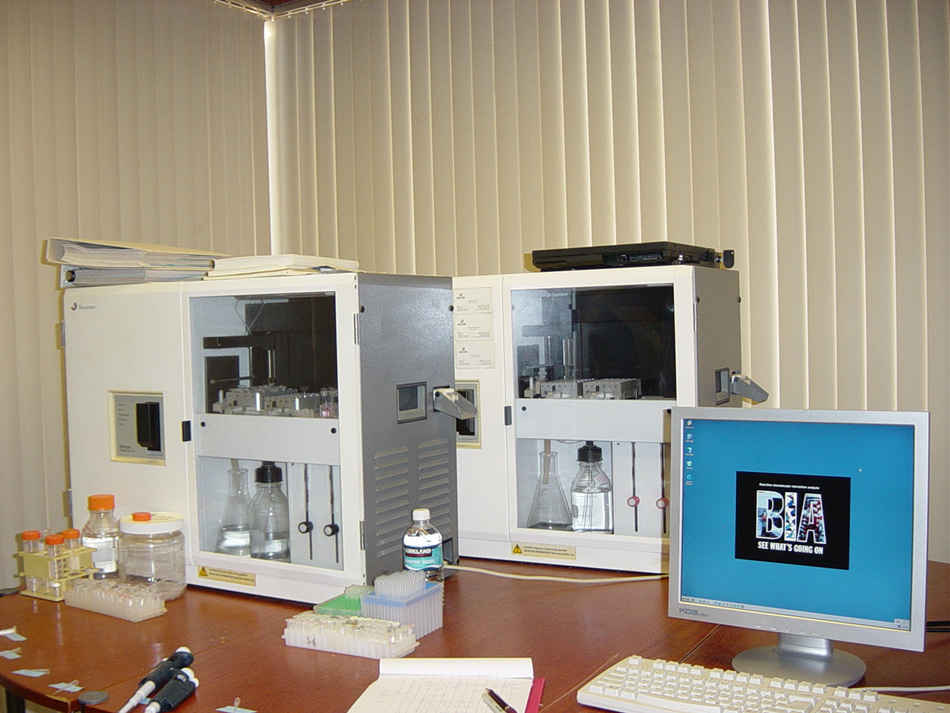
Biomolecular Interaction Analysis on Biacore(R) 1000A. You got a new protein, try to identify up-stream/down-stream interaction partners. Recovery capable SPR (surface plasmon resonance) enables you to purify them from cell lysates, so you can analyze them through mass spectrum and sequencing.  offers Biomolecular
Interaction Analysis service by using Biacore(R)
1000 (Five
units are available). Our scientists are among the first
generation of users back to early 90's (Xie Z, Reed JC. Methods
Enzymol. 2000;322:266-74). We will assist you to fulfill your task. offers Biomolecular
Interaction Analysis service by using Biacore(R)
1000 (Five
units are available). Our scientists are among the first
generation of users back to early 90's (Xie Z, Reed JC. Methods
Enzymol. 2000;322:266-74). We will assist you to fulfill your task.
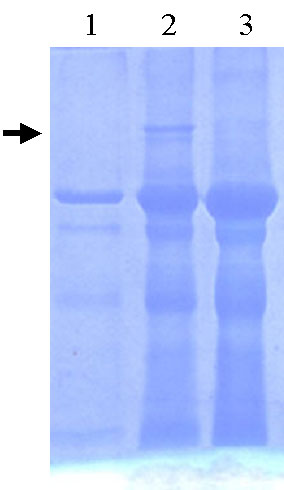
For individuals, our services range from confirming the interaction ("Yes or No" ) to performing detailed kinetic analysis (ka, kd, KD). Results will be presented in publishable form. This service is offered mainly to scientists who do not have time to go through this labor intensive analysis. There is a setting-up fee ($2800.00) for each project to cover equipment maintenance and initial assay development. The charge for each pair of interaction is $1200.00. The turnaround time is about 2 weeks. You need to provide 100~200ug of protein (95% pure). If you prefer, you may rent our equipment time at $28/hr (units are controlled by IBM Thinkpad, thus, you can take your dada with you, analyze them, and prepare the second day's run).For group (universities, companies, institutes), we offer site usage (you may renew it every year). Scientists without experience on Biacore analysis will be trained in our lab. Through this, if you feel this technology is good for your department, you may have confidence to set up your own facility since you already have trained scientists (good biacore analysis is dependent on both equipment (30%) and experienced scientists (70%). Biacore(R) is a registered trademark of Biacore AB, ProteinX Lab is not affiliated with Biacore International, AB or any of its subsidiaries Purification of IbeA receptor that contributes to E. coli invasion of BrainWe collaborate with researchers in USC to purify human receptors of IbeA by using Biacore. Purified IbeA was immobilized on CM5 chip, BMEC lysates were tested. Binding condition was optimized, then was used in affinity chromatography. Now, we have been able to identify a potential receptor of IbeA in human BMEC. Characterization of this receptor protein is underway.
1. IbeA used to purify receptor proteins
Updates on 3/1/05 Purified receptor band has been sequenced, and
the recombinant protein has been produced. It has been found that it interacts
with apoptosis proteins, and induce the apoptosis of BMEC. This is
a good explanation for E.coli invasion of brain.
Pegylation and Biacore Analysis
Biacore Analysis and GST fusion protein purification |
 |
 |